Frequently Asked Questions:
How can I demo VibroGuide?
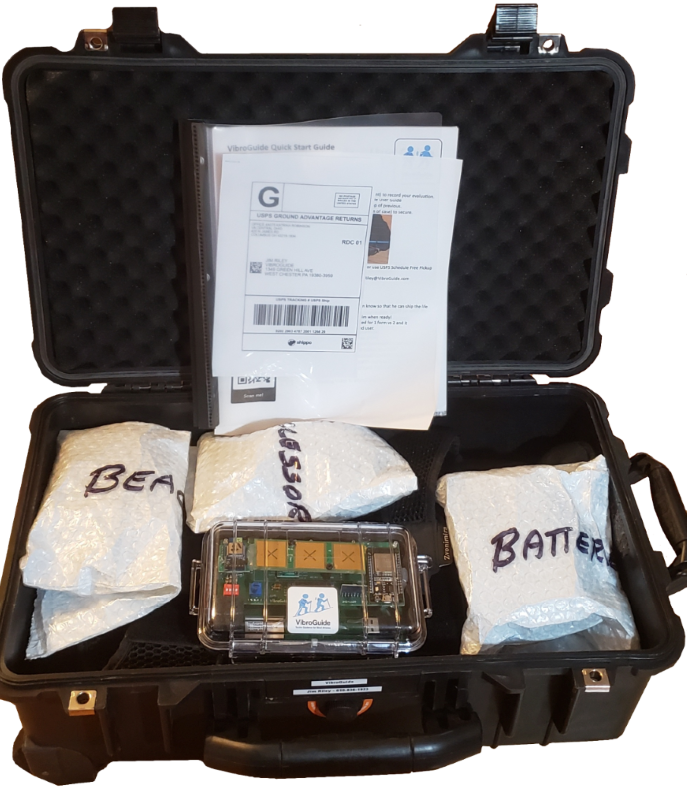
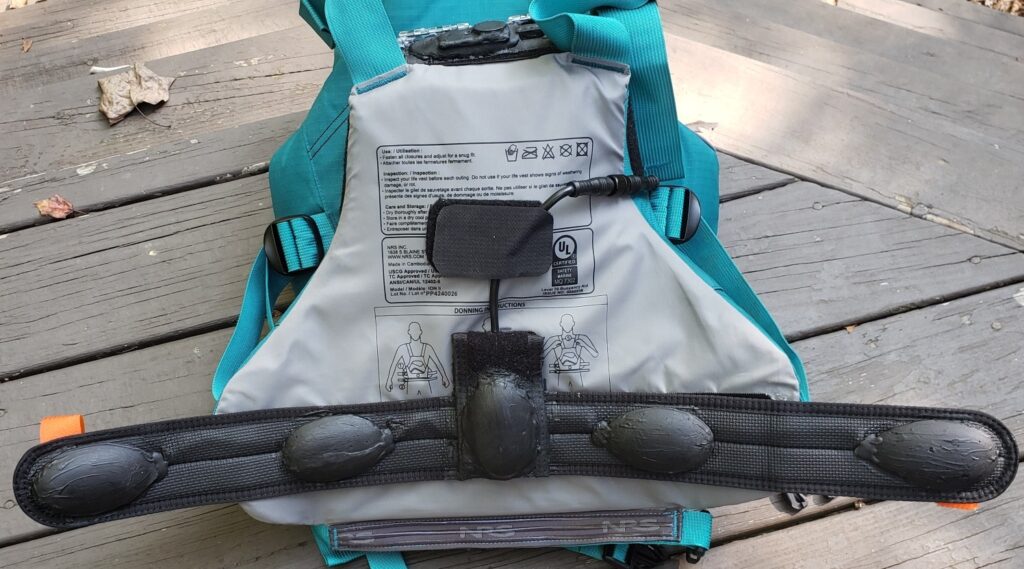
In person or on-site demos and training are preferred but we can ship VibroGuide sets for a limited demo period to approved individuals or institutions. An agreement is required to assure that the set is returned intact (usually within 30 days), that the equipment is not disassembled, that both positive and negative feedback is offered and of course, we welcome any photos or video of VibroGuide being used. The set would include a mesh sports vest, beacon, spare batteries and a user manual. If the demo set is expected to be used for watersports, we have several loaner life-jackets available to loan. This is an example of our prototype loaner set:
What is VibroGuide range?
The maximum range between guide and vest is about 75 feet (23 meters). This is measured outdoors with an unobstructed signal path. It is important to note that a guide should remain close enough to their blind athlete for easy hearing and speaking in order to safely communicate hazards or route changes. This can vary by individual but is typically 10-30 feet (5-10 meters) depending on the sport and the athletes hearing ability. Always….guides still need to guide!
What is the recommended VibroGuide team size?
While many activities can be comfortably guided with just a guide and blind athlete, it is always helpful to include a third person as an assistant or side-kick to the vest wearer so the real answer is three:
1) A leading guide carries a beacon and remains vigilant for hazards.
2) The blind athlete wearing the VibroGuide vest.
3) A side-kick assistant who travels near the blind athlete to serve as a backup to the lead guide as well companion who can describe the environment.
How long do batteries last?
The vest battery is rechargeable and with Squawk (announcement) ON, the expected battery life is between five and seven hours. It is always recommended to bring along a spare set of batteries if you are going to be outdoors for any length of time. Keep batteries charged so they are ready for use when you want them!
Does VibroGuide work indoors?
Not really. A Bluetooth signal is prone to reflection off furniture and walls as well as interference from appliances or WIFI. These signals often collide to lower the signal strength and can reflect off metal objects. This can cause directional errors sensed by the VibroGuide antenna. An open outdoor setting is the environment that VibroGuide was designed for and where it excels.
Why is GPS not used with VibroGuide?
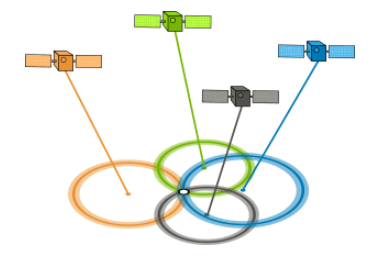
A common question. GPS is great for long distance navigation such as across town or a whole continent but falls short of our needs for close, active sports for several reasons: 1) GPS is slow on updates and lacks the resolution or accuracy to determine exactly where you are within about a 30 foot circle. This is evidenced when you make a wrong turn off a highway and many seconds pass before GPS alerts you that you made a wrong turn. Also, standard GPS resolution is not sufficient for active sports and blind guidance. GPS is also affected by changes in weather and open sky access.
Can I mute the announcement voice or turn down the vibration power?
Yes! Voice commands such as “Vest…Quiet” quiets the audible response. Other voice commands like, “Vest…Vibrate Low” or “Vest…Speed Fast” allows turning on or off various options. Saying “Vest…HELP” provides a list of available commands.
Can I use VibroGuide for water sports such as kayaking, paddle boarding or canoeing?
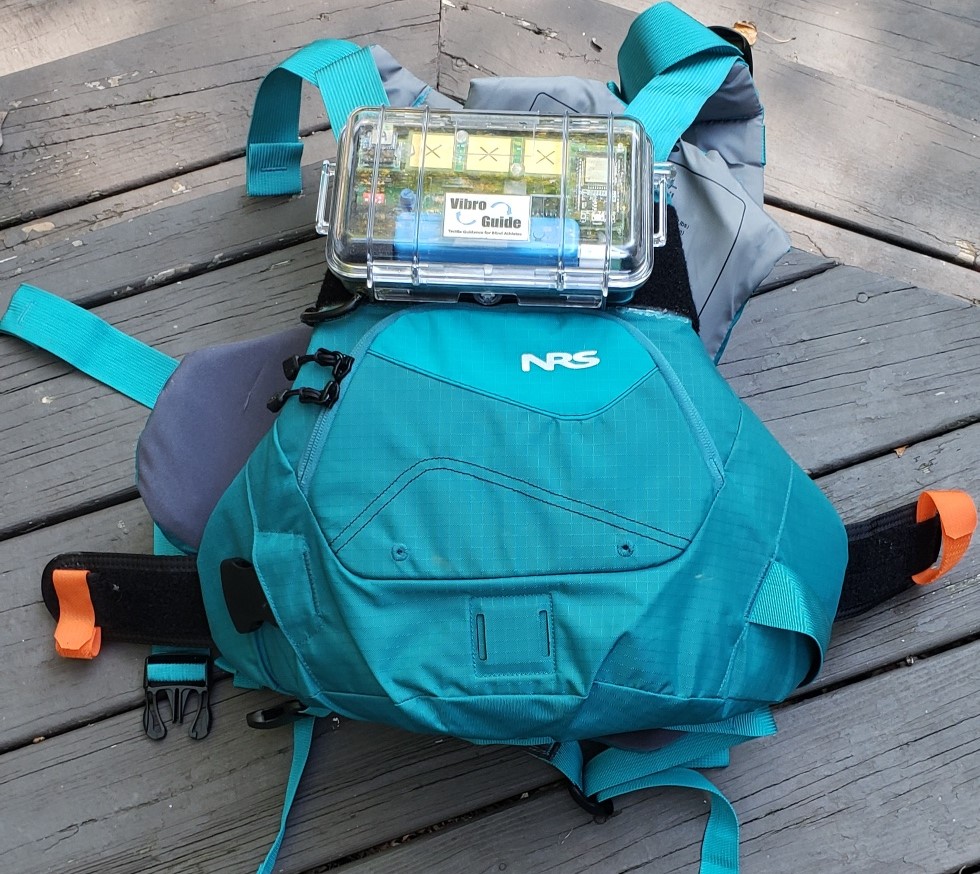
Yes! VibroGuide was originally designed for water sports. Wearing the beacon on an armband or clipped to a shoulder strap on a guides life jacket has worked well for our testing. A side-entry life vest (PFD) is modified with hook-and-loop pads glued on the front center for mounting the electronics. On the inside-front of the vest, hook-and-loop strips are glued to mount the modular vibration belt and to secure the cable. These are permanent alterations made to the life vest that have little effect on buoyancy. We may offer retrofits as a service or a DIY kit.
Can VibroGuide be used for skiing or winter sports?
Yes! The lightweight mesh sports vest can be worn under a parka or jacket with plastic zippers and still receive the guide beacon signal. It is advisable to keep metal objects like zippers or phones away from the electronic control unit to prevent absorption or reflection of the signal.
How much does the mesh sports vest weigh?
With all components including battery installed on the mesh sports vest, it weights a total of 2.5 pounds. The vest alone is about 1 pound and the control unit with battery, five vibration motors, cable/wiring and hook-and-loop pads add about 1.5 pounds.
How much does VibroGuide cost?
Good question! At this time, we have only produced prototype units which are expensive to build because component purchases are singular and labor is intense without a scaled production process. And… there really are no similar competing products being sold as a reference. Stay tuned!
What are the classic guidance methods for blind sports?
The Three T’s:
Tether: This employs a physical connection between a blind athlete and their guide. This provides immediate assurance to the athlete and changes in speed or direction are felt and translated immediately. The tether can be through touch with an arm, a shoulder or holding a hand but for fast moving sports such as marathon running, the use of a short rope, pole or bungee cord has been used.
As tether guidance is usually done by holding a rope or pole, there is a risk of soft-tissue injury to hands, arms or shoulders when the guide suddenly turns, stops, steps, trips or speeds up. A secondary issue is that tethering requires close proximity between guide and blind athlete.
Talk (or audible): This method requires a clear annunciation of navigation instructions by the guide such as “Left,” “Right” or “Stop.” Alternately, a guide can chant a regular phrase such as “ON ME” to provide a directional reference for the blind athlete to follow. With practice and optimal binaural (both ears) hearing, a blind person can learn to “proximity locate” on the guide by sensing the direction where the sound or chant is originating. This method has been used successfully by practiced teams of guides and blind kayakers on flat rivers and lakes and even in the turbulent whitewater of the Grand Canyon. More recently, wireless headset communication has been used for talk guidance. This method negates the ability to proximity locate (based on direction of sound) and places emphasis on verbal cues like, “turn left 45 degrees”, “come right”, “stop”, etc.
The downside of the talk/audible method is simply, fatigue. The voice of the guide can wear out from constant annunciation and the hearing of the blind athlete can degrade as it is absorbed with concentration on the guides verbal cues. Complicating this is when the guides voice is muted by wind, water or other ambient noise. Also, loud, regular announcement of “On-Me” (or any sound) is hardly discrete while outdoors and in nature.
Tactile: This method of guidance can be described as “feeling” a direction. When outdoors, a blind person can feel which side of their face is warmest to know where the sun is at. Combine that with the time of day and a blind person can obtain a general reference of North, East, South and West. Similar with wind being felt if the general direction is known. Another method may involve a tap on a shoulder or a vibration felt in a hat or vest. Depending on where a vibration is felt, it can provide an immediate reference on a desired direction. Tactile guidance is what VibroGuide offers with a wireless connection between a guide radio beacon and a blind athlete vest that calculates the location of the guide electronically.
The Fourth “T”: All of these methods require a sense of Trust between a guide and a blind athlete. A blind athlete must trust that their guide will remain vigilant for hazards, communicate clear instructions and adapt the pace or communication to what works well. A guide must trust that the blind athlete will follow directions, ask questions and communicate any difficulty they are having.
As part of Team River Runner winter Zoom education series, Jim Riley presents a discussion on blind guidance technology featuring his invention, VibroGuide.
54 minutes
Questions or Comments? Please see the Contact page.